.
My two monarch caterpillars are growing steadily. I check on them many times a day.
First, the question of names. I quickly rejected lame ideas like Tweedle Dee and Tweedle Dum, or Jeckyl and Hyde. Liz suggested Juan and Juanita, because they could end up wintering in Mexico. But those names didn't ring my bell. Since the little guys are monarchs, I decided on King George (the one we kicked out of North America), and Queen Elizabeth I.
Both have been through their first molt--the shedding of skin--to allow for growth. I think I can see the ghostly film of their shed skin, but it's too tiny and filmy to be sure. George is much bigger than Elizabeth--perhaps that's because he hatched a day earlier.


7/11/14
Raising monarch butterflies from the egg
.
No doubt you've heard about the precipitous decline of monarch butterflies, continent-wide.
When I was helping Wingra School with environmental education sessions, we decided to devote one session to butterflies. Stephanie Robinson ordered painted lady butterflies from Carolina Biological Supply, demonstrating how to raise them. On another day, the children planted butterfly weed, while parents purchased butterfly weed we supplied to plant at home.

We feel strongly that saving the Monarchs depends on exposing young children to the life cycle of butterflies. If kids haven't seen and don't understand this miracle, in the future no one will be motivated to do what's necessary to provide food plants and wintering habitat for the monarch.
No doubt you've heard about the precipitous decline of monarch butterflies, continent-wide.
When I was helping Wingra School with environmental education sessions, we decided to devote one session to butterflies. Stephanie Robinson ordered painted lady butterflies from Carolina Biological Supply, demonstrating how to raise them. On another day, the children planted butterfly weed, while parents purchased butterfly weed we supplied to plant at home.
We feel strongly that saving the Monarchs depends on exposing young children to the life cycle of butterflies. If kids haven't seen and don't understand this miracle, in the future no one will be motivated to do what's necessary to provide food plants and wintering habitat for the monarch.
5/5/14
Experimental rain garden proposed for Hamilton School
.
There's growing recognition that the best way to cleaner lakes is to improve the watershed around them--including more infiltration of rainwater, less erosion, and more biodiversity.
The Friends of Lake Wingra undertook a survey of the watershed. One finding was that swales--shallow grassy depressions used to manage stormwater--were present everywhere and could be modified to improve infiltration. Every school we surveyed had swales, often in areas that have no other use.

At some schools such as Lincoln, Midvale, Hamilton, and Toki, over time the swales have changed* so they no longer perform their function of carrying away stormwater. The result--large puddles that turn to mud or slick ice, creating a nuisance.
Swales are linear depressions in turf, usually in sunny locations. With little effort, they can be turned into rain gardens by the creation of shallow dams, then planted with native prairie species.
What's needed is a test of this concept, to see if we can find a method that requires minimal labor and expense. We hope to demonstrate that benefits will outweigh any increased maintenance or loss of open lawn.
There's growing recognition that the best way to cleaner lakes is to improve the watershed around them--including more infiltration of rainwater, less erosion, and more biodiversity.
The Friends of Lake Wingra undertook a survey of the watershed. One finding was that swales--shallow grassy depressions used to manage stormwater--were present everywhere and could be modified to improve infiltration. Every school we surveyed had swales, often in areas that have no other use.
Swale at Midvale School during a severe storm.
Swales are linear depressions in turf, usually in sunny locations. With little effort, they can be turned into rain gardens by the creation of shallow dams, then planted with native prairie species.
What's needed is a test of this concept, to see if we can find a method that requires minimal labor and expense. We hope to demonstrate that benefits will outweigh any increased maintenance or loss of open lawn.
5/1/14
Meeting on proposed new building on Monroe St.
.
Updated 5/3/14
Neighbors are invited to attend and participate in a discussion on a proposed development at 3414 Monroe Street by developer, Patrick Corcoran.
This site is at the corner of Monroe and Glenway, across Glenway from Parman's Place.
The proposal involves demolishing the current building and constructing a new mixed-use (commercial/residential) building.
Meeting Monday, May 5th, 6:30pm
Wingra School Library
Neighbors are invited to attend and participate in a discussion on a proposed development at 3414 Monroe Street by developer, Patrick Corcoran.
This site is at the corner of Monroe and Glenway, across Glenway from Parman's Place.
The proposal involves demolishing the current building and constructing a new mixed-use (commercial/residential) building.
The "Save our Lakes" breakfast
.
On April 25, the Clean Lakes Alliance held its annual fundraiser breakfast at Monona Terrace. There were at least 5 speakers, including Mayor Paul Soglin and County Executive Joe Parisi.

Steven Carpenter, from the UW's Laboratory of Limnology, spoke briefly about "the state of our lakes." Basically, our lakes are holding their own--neither improving nor declining--despite all the efforts at correcting their problems.
The ups and downs we have recently seen in lake clarity are simply due to whether it has been a year with lots of runoff, versus a year of drought.
The decorations were stunning, including hanging mobiles depicting the many species of fish in our lakes, made by school children just for this event. Behind luminous blue curtains, videos of waves and bubbles reproduced an underwater environment (someplace much cleaner than our lakes). It felt like we were dining like mermaids, beneath the waves.

More photos
On April 25, the Clean Lakes Alliance held its annual fundraiser breakfast at Monona Terrace. There were at least 5 speakers, including Mayor Paul Soglin and County Executive Joe Parisi.
Steven Carpenter, from the UW's Laboratory of Limnology, spoke briefly about "the state of our lakes." Basically, our lakes are holding their own--neither improving nor declining--despite all the efforts at correcting their problems.
The ups and downs we have recently seen in lake clarity are simply due to whether it has been a year with lots of runoff, versus a year of drought.
The decorations were stunning, including hanging mobiles depicting the many species of fish in our lakes, made by school children just for this event. Behind luminous blue curtains, videos of waves and bubbles reproduced an underwater environment (someplace much cleaner than our lakes). It felt like we were dining like mermaids, beneath the waves.
More photos

1/29/14
Zombie bill comes back from dead to attack environment
.
We're hearing rumors that SB 349 – the bill that would take away the power of local communities from making their own decisions about things like frac sand mining and factory farms – is coming up – and soon.
We're hearing rumors that SB 349 – the bill that would take away the power of local communities from making their own decisions about things like frac sand mining and factory farms – is coming up – and soon.
11/22/13
A tar sands mine in Madison ??
.
Madison has its own version of the tar sands--an asphalt and concrete recycling operation near the corner of the Beltline and Verona Rd. Next door is a staging area for the stormsewer work going on along the beltline.


Madison has its own version of the tar sands--an asphalt and concrete recycling operation near the corner of the Beltline and Verona Rd. Next door is a staging area for the stormsewer work going on along the beltline.


11/15/13
Time to end "business as usual"
.

At the climate talks now underway in Poland, the Philippine delegate, Naderev Sano, said:
"To anyone outside who continues to deny and ignore the reality that is climate change, I dare them -- I dare them to get off their ivory towers and away from the comfort of their armchairs.
I dare them to go to the islands of the Pacific, the Caribbean, the Indian Ocean, and see the impacts of rising sea levels; to the mountainous regions of the Himalayas and the Andes, to see communities confronting glacial floods; to the Arctic, where communities grapple with the fast-dwindling sea ice sheets; the large deltas of the Mekong, the Ganges, the Amazon, the Nile, where lives and livelihoods are drowned; to the hills of Central America, that confront similar monstrous hurricanes; to the vast savannas of Africa, where climate change has likewise become a matter of life and death as food and water becomes scarce -- not to forget the monstrous storms in the Gulf of Mexico and the Eastern Seaboard of North America, as well as the fires that have raged Down Under.
And if that is not enough, they may want to see what has happened to the Philippines now."
We are entering a crisis of epic proportions. We caused it. It's no longer enough to make one token effort for climate change. Everyone has to make multiple efforts.
Our current lifestyle is what caused this crisis. We have to change how we live. There's no other way.
For the sake of your grandchildren.

Tornado over Stoughton.
At the climate talks now underway in Poland, the Philippine delegate, Naderev Sano, said:
"To anyone outside who continues to deny and ignore the reality that is climate change, I dare them -- I dare them to get off their ivory towers and away from the comfort of their armchairs.
I dare them to go to the islands of the Pacific, the Caribbean, the Indian Ocean, and see the impacts of rising sea levels; to the mountainous regions of the Himalayas and the Andes, to see communities confronting glacial floods; to the Arctic, where communities grapple with the fast-dwindling sea ice sheets; the large deltas of the Mekong, the Ganges, the Amazon, the Nile, where lives and livelihoods are drowned; to the hills of Central America, that confront similar monstrous hurricanes; to the vast savannas of Africa, where climate change has likewise become a matter of life and death as food and water becomes scarce -- not to forget the monstrous storms in the Gulf of Mexico and the Eastern Seaboard of North America, as well as the fires that have raged Down Under.
And if that is not enough, they may want to see what has happened to the Philippines now."
We are entering a crisis of epic proportions. We caused it. It's no longer enough to make one token effort for climate change. Everyone has to make multiple efforts.
Our current lifestyle is what caused this crisis. We have to change how we live. There's no other way.
For the sake of your grandchildren.
11/5/13
Catholic Multicultural Center plans a community rain garden
.
Now the EAP has a new grant to expand their program to include other cultures and languages. Maria Moreno. who is leading this new program, said they are beginning to work with Community Centers, because that's where you reach Latin Americans.
Recently, I learned that the Catholic Multicultural Center(CMC) is planning to involve their community in building a rain garden on the Center's grounds.

The first public meeting will be on Nov. 12, 6-7 pm, at 1862 Beld St. (If you want to attend, contact Laura Green at 441-1180 (volunteer@cmctoday.org).
Laura is planing educational programs related to the garden once a month over the winter, with "construction day" on May 14. They hope to make construction day a "community event," with activities, including speakers and a dance group. They hope to create a "ripple effect--the rain garden will be one activity helping to foster pride in the neighborhood.
Your organization or business can help
Laura is hoping that many organizations and businesses can help. Early commitments of support can help the CMC expand their plans, to make the project an example of how an organization can improve their stormwater management, to improve the health of our lakes.
Laura Green, Antonio, Steve Glass, and I talked about the potential for creating a "ripple effect" by creating pride in the community.
One possibility is to offer three free plants to volunteers to help construct the rain garden. Those volunteers would take the plants home to build a "mini rain garden" at the end of their downspout.
To provide incentive, the CMC would conduct a raffle--all volunteers with a "mini garden" would be entered in the raffle. The winner would receive a valuable gift certificate from a local business.


The UW Arboretum has an established and successful program called Earth Partnership for Schools (EPS). They help schools around the country build restorations of native communities, and then incorporate those natural plantings into their lessons.
Now the EAP has a new grant to expand their program to include other cultures and languages. Maria Moreno. who is leading this new program, said they are beginning to work with Community Centers, because that's where you reach Latin Americans.
Recently, I learned that the Catholic Multicultural Center(CMC) is planning to involve their community in building a rain garden on the Center's grounds.

Numbers show potential community rain garden sites.
Laura is planing educational programs related to the garden once a month over the winter, with "construction day" on May 14. They hope to make construction day a "community event," with activities, including speakers and a dance group. They hope to create a "ripple effect--the rain garden will be one activity helping to foster pride in the neighborhood.
Your organization or business can help
Laura is hoping that many organizations and businesses can help. Early commitments of support can help the CMC expand their plans, to make the project an example of how an organization can improve their stormwater management, to improve the health of our lakes.
Laura Green, Antonio, Steve Glass, and I talked about the potential for creating a "ripple effect" by creating pride in the community.
One possibility is to offer three free plants to volunteers to help construct the rain garden. Those volunteers would take the plants home to build a "mini rain garden" at the end of their downspout.
To provide incentive, the CMC would conduct a raffle--all volunteers with a "mini garden" would be entered in the raffle. The winner would receive a valuable gift certificate from a local business.

Two potential sites for the community rain garden are shown here. The above photo is the current top choice, since it's visible from the dining area.
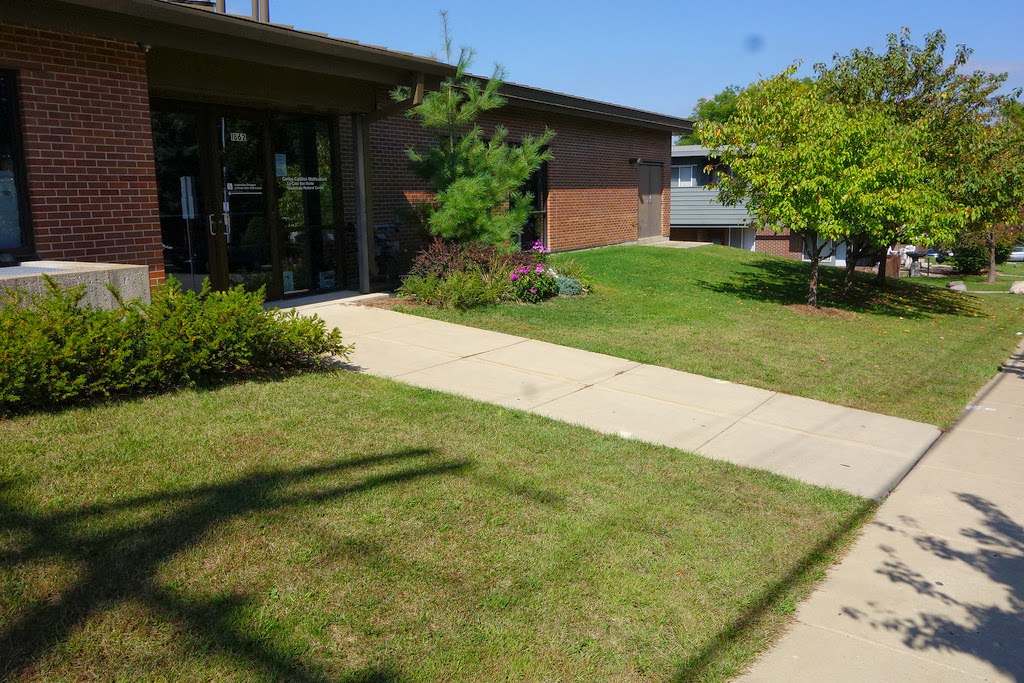
However, this location might be better, since it receives more runoff, and is more visible to the community.
Subscribe to:
Posts (Atom)


 Posts

